15
Jun
The saliva and stomach contents of ticks carry the pathogens. Removing the embedded tick creates a small open wound that bleeds slightly.

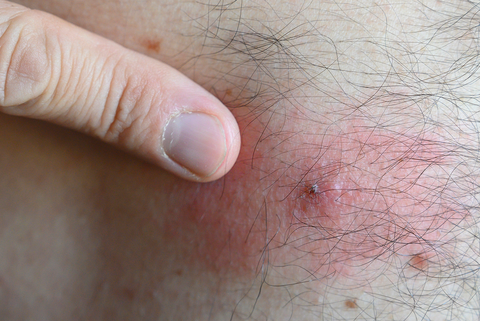
Tick entry wound. The tick injects an anesthetic into the skin at its point of entry which helps it avoid detection so it can continue feeding. Many patients with the tick-borne disease Lyme disease dont recall having a bug bite of any kind. Do ticks burrow completely under the skin.
In general ticks do not burrow completely under the skin. Simple uncomplicated tick bites are treated with routine wound care topical corticosteroids and systemic antihistamines for pruritic lesions and antibiotics if secondary infection is present. Ticks should be removed with fine-tipped tweezers grasping the tick as close to the skin as possible and pulling upward with steady gentle pressure.
For example the tick secretes an adhesive cement-like substance shortly after insertion of the mouthparts to anchor itself in the skin. Subsequently saliva composition shifts to proteins that facilitate acquisition of the bloodmeal and immune evasion and eventually wound healing and detachment from the host 23143144. The Bulls Eye wound usually develops between 3 days to 1 month after the human host receives a bite from an infected tick.
At first a red patch appears over the site of the bite which grows larger. In the early stages the red patches vary in size and shape but as they expand they take on a large circular appearance resembling a bulls eye. The incubation period time from exposure to illness is usually between 3 and 21 days average 10 days.
However it may range from one day to several months depending on the kind of wound. Most cases occur within 14 days. In general doctors see shorter incubation periods with.
More heavily contaminated wounds. Ixodes tick saliva contains substances that seal the wound and anticoagulants and anti-inflammatory components that aid in engorgement. Borrelia burgdorferi may take advantage of at least two of the salivary components that appear to facilitate transmission from tick to mammal.
To remove an embedded tick in your dog the tick needs to be removed in whole. Put on the rubber gloves. Removing the embedded tick creates a small open wound that bleeds slightly.
Fill three-fourths of the plastic cup with rubbing alcohol. This will immediately kill the tick. Ticks are blood feeding parasites.
Ticks are known as vectors because they can transmit different pathogens responsible for several diseases including Colorado Tick Fever Rocky Mountain Spotted Fever RMSF Tularemia and relapsing feverWhile there are 27 species of ticks in Colorado almost all human encounters w ticks in Colorado involve the Rocky. If the skin is cut the wound must be closed to prevent blood loss and the entry of pathogens. The formation of a scab does just that.
Blood contains tiny fragments of cells called. Entry Wounds is a harrowing supernatural thriller filled with shootouts bloodshed betrayaland best of all a cursed revolver. As the body count rises so too does the action in a roller coaster ride of a story that concludes with a fantastic twist I never saw coming.
Since the tick is still attached to an open wound they will vomit directly into your body. The saliva and stomach contents of ticks carry the pathogens. Ticks suborder Ixodida are parasitic arachnids that are part of the mite superorder ParasitiformesAdult ticks are approximately 3 to 5 mm in length depending on age sex species and fullness.
Ticks are external parasites living by feeding on the blood of mammals birds and sometimes reptiles and amphibians. The timing of the origin of ticks is uncertain though the. Skin provides tough flexible outer covering But exposed state makes vulnerable to injuries Cuts punctures burns chemical injury and insect or tick bites can break barrier provide entry for pathogens Staphylococcus aureus can enter surgical wound invade bloodstream Sandfly bites can introduce Leishmania species cause of leishmaniasis Skin infections can occur when.
Wound care Your nurse will tick the sections which apply to you. Radial wrist artery 1. The dressing or plaster can be removed the day after the procedure.
Avoid lifting any heavy bags or doing any strenuous activity for 3 days as this increases the pressure in your wrist area making it more likely that the wound will bleed. Step 5 Portal of entry the manner the infection enters the body of a person refers to the portal of entry. Frequently a pathogen uses the same portals of exit and entry.
In Maggie it may be an open wound or surgical incision. Once a tick finds a host such as a human a pet dog or cat a deer or a rabbit and finds a suitable site for attachment the tick begins to burrow with its mouthparts into exposed skin. Tick mouthparts are barbed which helps to secure them to the host.
Often the tick secretes cementum to more firmly attach its mouthparts and head to the host. Three reviews are recommended in the 30-day follow-up periodFor each Event please record the date tick the Antibx column if antibiotics are prescribedbeing taken complete health workers initials and record any surgical site infection SSI symptoms or other important notes in the last column see footnote 1. Check your clothing for ticks.
Ticks may be carried into the house on clothing. Any ticks that are found should be removed. Tumble dry clothes in a dryer on high heat for 10 minutes to kill ticks on dry clothing after you come indoors.
If the clothes are damp additional time may be needed. If the clothes require washing first hot water is recommended. Skin wounds caused by ticks can lead to secondary bacterial infections and screwworm infestations.
Severe tick infestations can lead to anemia and death. Use forceps tweezers with medium or fine blunt tips to grasp the tick as close to the point of entry as possible. This may mean depressing the skin of the victim where the tick is half-buried exposing the head of the tick if at all possible.
Grasp the head of the tick and begin pulling steadily. Be patient do not jerk the tick and. Bovine babesiosis bb is a tick-borne disease of cattle.
Transmission of b bovis takes place when engorging adult female ticks pick up the infection. They pass it on to their progeny via their eggs. Larvae or seed ticks then pass it on in turn when feeding on another animal.
B bigemina is also passed from one generation of ticks to the next. A deep wound left open air could easily become contaminated and exposed organ tissue could become dry and ischemic. Covering the wound with a most sterile dressing is the first actin the nurse should take to prevent further injury.
Tick activity is stimulated by movement air currents and carbon dioxide exhaled by horses. The goal is to prevent ticks from attaching to your horse and possibly spreading an illness and the best way to achieve this is to start by managing your horses environment.
Previous post
Tick vs miteNext post
Throwing up food and shivering